The State of Ecommerce Trust in 2026: AI fears, trust badges, and what makes shoppers click buy
Every two years, we survey consumers to get inside their heads and find out what shapes their trust in the sites they shop. This is our fifth wave, and our largest yet: 1,295 US shoppers told us what worries them, what makes a site look fake, and what gives them the confidence to complete a purchase.
The backdrop this year is hard to ignore. US consumers lost $38 billion to identity fraud and scams in 2025, and Javelin's researchers now point to AI as a force actively eroding consumer trust. Our data says shoppers feel it. The trust gap on unfamiliar sites has been stubborn for years, and in 2026, AI may be making it harder to close. Here is what we found, and what it means for your store.
Shoppers still don't trust sites they don't know
How concerned are you about providing personal information (e.g., credit card, address, phone number) when shopping online at each of the following types of websites?
The oldest finding in our research is also the most durable. When we ask how concerned people are about sharing personal information across different kinds of sites, the answer depends almost entirely on familiarity.
In 2026, 96% of shoppers are concerned about sites they have never heard of, and 94% feel the same about sites they simply haven't bought from before. Compare that to large, established sites like Amazon, where concern drops to 48%, or sites where they have shopped in the past, at 54%. The pattern has barely moved in eight years. Familiarity is trust, and a site nobody recognizes starts the relationship in a hole.
Concern about sharing personal information, by site familiarity (2018–2026)
That is the gap every new or growing store has to close. The rest of our findings are really about what widens it, and what closes it.
AI is creating new reasons for doubt
We first asked about AI in 2024, when 87% of shoppers said they were concerned about its misuse in online shopping. In 2026 that figure ticked up to 88%. A modest rise on its own, but the real story is underneath the headline.
How concerned are you about each of the following AI-related risks when shopping online?
This year we asked about specific AI-driven threats for the first time, and the numbers are striking:
- 94% are concerned about fake businesses created with AI-generated content.
- 93% are concerned about AI-generated phishing emails impersonating retailers.
- 91% are concerned about fake product reviews written by AI.
When you put a concrete scenario in front of people, concern jumps past 90% every time. The worry is backed by real losses. The FBI reported $893 million in losses tied to AI-related scams. And according to the FTC, shopping scams were the most reported type of social media scam last year, many of them routing shoppers to unfamiliar or spoofed sites.
This is one reason the familiarity gap may matter more than it used to. AI lets bad actors fake legitimacy at scale: convincing storefronts, plausible reviews, polished emails. The shopper's old shortcut, "this looks professional, so it's probably real," no longer holds. So they fall back on the hardest question of all for a new merchant to answer: have I heard of this before?
The biggest fear isn't always what stops the sale
One of the more interesting tensions in this year's data shows up here. When we ask shoppers for their single biggest concern, the security of their credit card information comes out on top at 24%, with business legitimacy second at 16%. That has been the pattern for years.
What is your biggest concern when shopping online?
But when we ask what has actually made them abandon a purchase, the order flips. Business legitimacy is the number one reason, cited by 51% of shoppers, up more than five points from 2024. Credit card security is second, at 43%.
Biggest stated concern vs. what has actually made shoppers abandon a purchase
Why would the biggest fear not be the biggest dealbreaker? Our read is that credit card fear comes with a safety net. Shoppers have been trained to feel protected by chargebacks, zero-liability policies, and tokenized payment methods like Apple Pay and PayPal. The worry is real, but the downside feels recoverable, so they proceed.
A fake business has no such safety net. If the company itself is illegitimate, there's no way to know what the scammer will do with your data. That asymmetry is why questionable legitimacy stops more sales than any other concern, even though it isn't the loudest fear. For a merchant, it points to a clear priority: prove you are a real business before you reassure anyone about anything else. (Worth noting: 89% of shoppers have abandoned at least one purchase over a concern. Only 11% never have.)
What makes a website look fake
Have you ever started to purchase an item online only to abandon the purchase because of any of the following concerns?
If legitimacy is the question, what are the answers shoppers use to judge it? We asked what makes them suspect a site might be fraudulent. The top signals in 2026:
- Pricing that's too good to be true: 65%
- Typos and grammatical errors: 59%
- Never having heard of the site before: 56%
- Missing contact information: 46%
- A lack of third-party trust indicators like certifications, badges, or logos: 40%
- Broken links: 40%
Most of these are within a merchant's control. Clean copy, visible contact details, working links, and honest pricing all clear the low bar. The absence of trust indicators can be easily addressed with earned website certifications and trust badges. About 4 in 10 shoppers read a missing trust badge as a possible sign of fraud.
Trust badges still move shoppers
So we come to the resolution. When shoppers land on an unfamiliar site, what restores the confidence the familiarity gap takes away?
When shopping on an unfamiliar website, how much more likely are you to trust a site that prominently displays a third-party verified trust badge compared to one that does not?
In 2026, 82% of shoppers say they are more likely to trust a site that prominently displays a third-party verified trust badge than one that does not. That figure has held steady across our last two surveys, which marks it as stable behavior rather than a passing trend.
Which of the following statements verified by a third-party entity would increase the likelihood of making a purchase on an unfamiliar site?
We also asked which verified statements would most increase someone's likelihood of buying on an unfamiliar site:
- Data Protection (data is encrypted and kept private): 51%
- Verified Business (key contact information has been validated): 50%
- Certified Secure (no malware, phishing, or malicious links): 44%
The top of that list maps neatly onto the concerns shoppers told us about: data security and business legitimacy. The verifications that move the needle are the ones that answer the questions keeping people from clicking buy.
3 in 4 shoppers are more likely to buy when they see the TrustedSite badge
This year, for the first time, we asked specifically about our own badge. The results reflect what we've seen across much of our internal research.
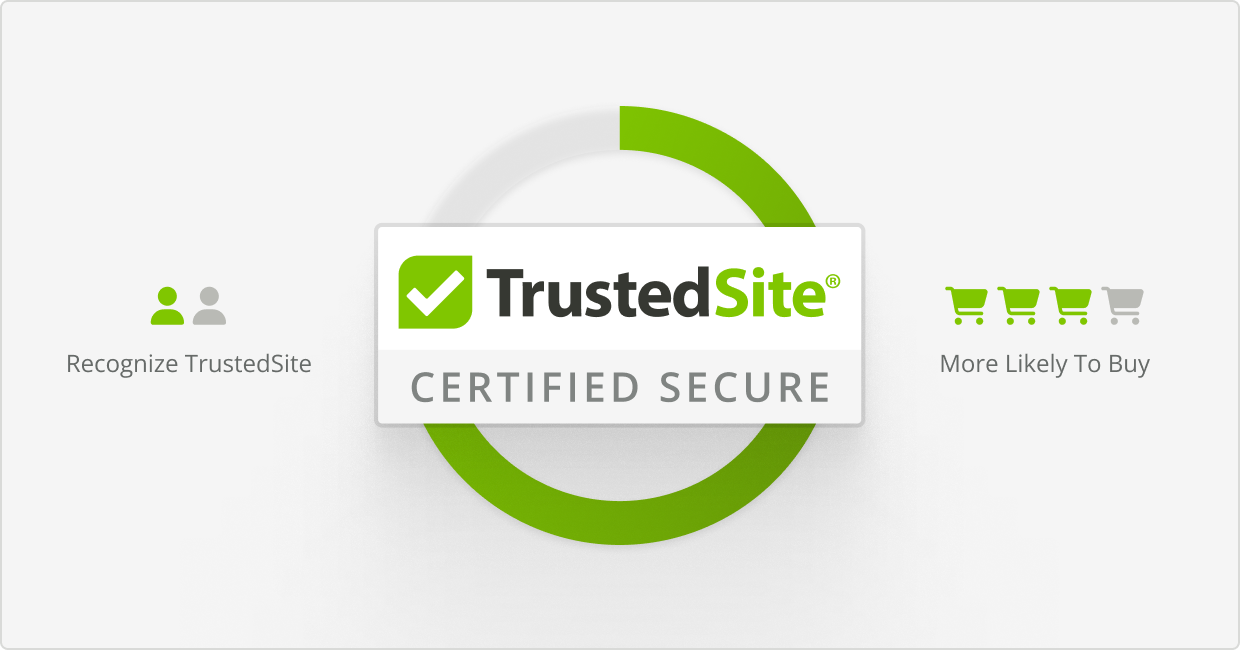
74% of shoppers said they would be more likely to complete a purchase on an unfamiliar site if they saw the TrustedSite badge. And with over 400,000 websites displaying the TrustedSite badge, it's no surprise that over half of shoppers (53%) told us they already recognize the TrustedSite badge from their own shopping.
What shoppers say in a survey is one thing. What they do in a real checkout is another, and the A/B tests back it up. When merchants have tested TrustedSite badges against a control, they have measured real lift: Cariloha saw a 4.7% increase in conversions, OnTime Supplies saw a 19.7% increase in conversions, and dozen of others sites have found similar results. Shoppers say the badge moves them, and the tests show it does.
What this means for your store
Pulling the threads together, the 2026 data points to three priorities for any business trying to earn a new visitor's trust:
- Prove you're a real business. Legitimacy is the top reason shoppers abandon carts. Verified Business validates the real contact details behind your store.
- Show that data is safe. Data protection is the single most persuasive verification. Certified Secure and Data Protection demonstrate your site is monitored and your shoppers' information is encrypted.
- Display verification shoppers recognize. A badge only works if people trust it. With more than half of shoppers already recognizing it, the TrustedSite badge is a signal they know.
The unfamiliar-site trust gap isn't going away, and AI is making it harder to cross on looks alone. The stores that win the next visitor will be the ones that can prove, quickly and credibly, that real people and real safeguards stand behind the site. We're already curious how this picture shifts by 2028.
Ready to address your visitors' doubts?
Add the TrustedSite badge to your website today.
TrustedSite surveyed 1,295 US consumers via SurveyMonkey Audiences in 2026. Concern figures exclude "N/A" responses and are based on consumers who answered each question. Percentages may not sum to 100% due to rounding. Year-over-year comparisons reference our prior surveys from 2018, 2020, 2022, and 2024.